Sustainable nonwovens
The nonwovens market has rapidly changed towards sustainable alternatives. Main drivers being consumers’ growing awareness of environmental issues and legislation. EU’s Single-Use Plastics Directive drives global emphasis on plastic free products. We at Suominen are well positioned to respond to this change. We launched our first plastic-free product already over 15 years ago.
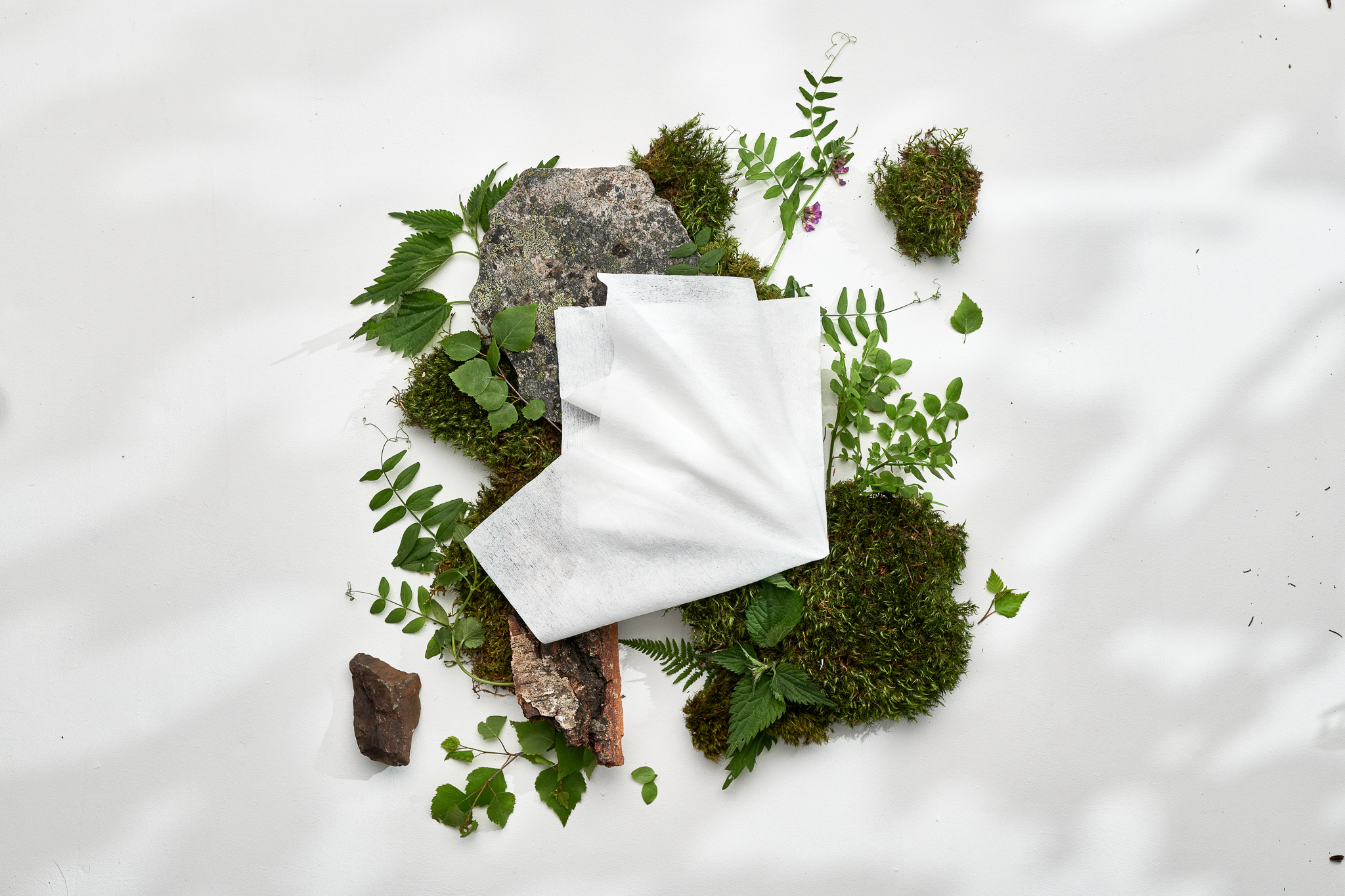
Our product portfolio consists of a wide range of sustainable nonwoven products for different applications. In our plastic-free offering, we have products that are biodegradable, compostable, or dispersible. The products are made of renewable fibers such as viscose, pulp, lyocell, cotton or bamboo. In addition to renewable fibers, we also provide nonwovens made from other sustainable sources such as recycled rPET or PLA.
Sustainable nonwovens is one of the four focus areas in our Sustainability Agenda. In our Sustainability Agenda 2025–2030 our target is that two thirds of consumed raw materials are from plant-based resources, and that over 50% of our new R&D initiatives focus on advancing the development of sustainable products. Suominen continuously seeks solutions to reduce the environmental impacts of nonwoven products throughout the entire value chain. We actively evaluate new, innovative, and responsible fibres for our products.
We direct more than half of our new R&D initiatives to support testing new raw materials and the development of new sustainable products (e.g. Green Lab compostability center), services and processes. Target progression is followed as a relative target: new R&D initiatives focusing on advancing the development of sustainable products, compared to the total number of new R&D initiatives. In 2025, 50% of new R&D initiatives focused on advancing the development of sustainable products.
Regarding our material use, we aim that more than two thirds of the consumed raw materials will be from plant-based resources by 2030. Raw materials play a vital role in the manufacturing of nonwovens. By prioritizing sustainable virgin and recycled plant-based raw materials, Suominen strengthens its offering of sustainable and high-performing products to reduce dependence on non-renewable raw materials. Target progression is followed as a relative target, plant-based raw material use compared to total raw material use. The percentage is absolute volume based and the measuring unit for raw material use is tons. In 2025, 62% (62%) of consumed raw materials were from plant-based resources.
Continuous development
Sustainability is one of the key themes in our R&D. We are a pioneer in producing sustainable nonwovens, and our R&D team has excellent know-how in sustainable fibers. Our pilot lines and R&D labs at Nakkila and Windsor Locks sites support our innovation work by, for example, enabling the testing of prototypes.
We are constantly researching new annual fibers in general, as an example, nettle and hemp, and regenerated cellulose in our New Fiber Center. Active cooperation with our suppliers, customers and other players in the market developing new innovative fibers is a cornerstone of our product development.
On top of researching new raw materials, we focus on the end-of-life and biodegradability of renewable raw materials. The Suominen Green Lab in Nakkila has been in operation since 2022. The lab supports sustainable product development and validates claims that products are compostable. By continuously developing new and innovative solutions with a reduced environmental impact, we are able to provide a comprehensive offering of sustainable nonwovens to our customers.
In addition to creating new sustainable products, we see the importance of evaluating and minimizing the environmental impacts of all our existing products. Since 2021, we have evaluated the climate impacts of our products by calculating their carbon footprints. By offering products with a lower climate or nature burden without compromising on quality, we can support our customers in reducing the environmental impact of their own products and achieving their own sustainability goals.
Our aim is to grow our sustainable product portfolio even further for the benefit of our customers.
Suominen’s sustainable products
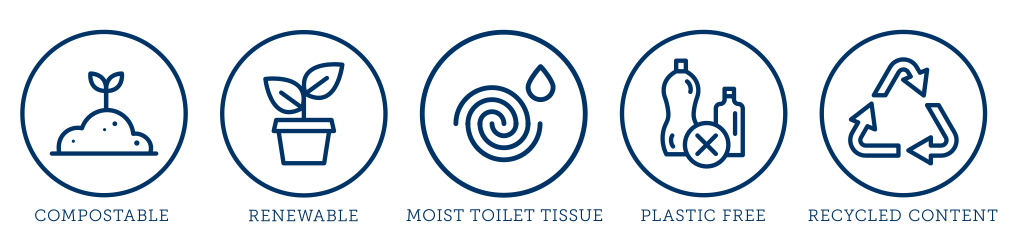
Suominen’s nonwovens create value for our customers and end-users by offering safe and high-quality wiping, medical and hygiene products and diverse sustainable alternatives, including biodegradable, compostable and plastic-free products and products manufactured using recycled materials. Our sustainable products have to fulfill at least one of the following criteria: products are made of renewable, plastic-free or partially recycled raw materials or are compostable or dispersible nonwovens.
Below is a simplified visual guide to understanding some basics within sustainable options, and how certain raw materials can contribute to a nonwoven’s sustainability.

Certifications
Suominen offers traceability certifications like FSC®, PEFC and SFI®, as well as skin-safe certifications like STANDARD 100 by OEKO-TEX®. For dispersible grades, Suominen manages INDA / EDANA compliance certificates.